15.7 Reference Cycles Causing Memory Leaks
15.7.1 Memory Leaks
Rust’s extremely high level of safety makes memory leaks hard to happen, but not impossible.
For example, using Rc<T> and RefCell<T> can create reference cycles and cause memory leaks: the reference count of each pointer never decreases to 0, so the values are never cleaned up.
Take a look at an example:
use crate::List::{Cons, Nil};
use std::cell::RefCell;
use std::rc::Rc;

#[derive(Debug)]
enum List {
    Cons(i32, RefCell<Rc<List>>),
    Nil,
}

impl List {
    fn tail(&self) -> Option<&RefCell<Rc<List>>> {
        match self {
            Cons(_, item) => Some(item),
            Nil => None,
        }
    }
}

fn main() {
    let a = Rc::new(Cons(5, RefCell::new(Rc::new(Nil))));

    println!("a initial rc count = {}", Rc::strong_count(&a));
    println!("a next item = {:?}", a.tail());

    let b = Rc::new(Cons(10, RefCell::new(Rc::clone(&a))));

    println!("a rc count after b creation = {}", Rc::strong_count(&a));
    println!("b initial rc count = {}", Rc::strong_count(&b));
    println!("b next item = {:?}", b.tail());

    if let Some(link) = a.tail() {
        *link.borrow_mut() = Rc::clone(&b);
    }

    println!("b rc count after changing a = {}", Rc::strong_count(&b));
    println!("a rc count after changing a = {}", Rc::strong_count(&a));
}- First, we create a linked list
List, wrappingRc<T>inRefCell<T>so that the internal value can be modified. - Through an
implblock, we define a method calledtailforList, which gets the second element carried by theConsvariant. If it exists, it returns the value wrapped inSome; if it isNil, it returnsNone. - Then in
main, we create twoListinstances,aandb, andbinternally shares the value ofa. This kind of linked-list code is ugly to look at, so I put the structure diagram here: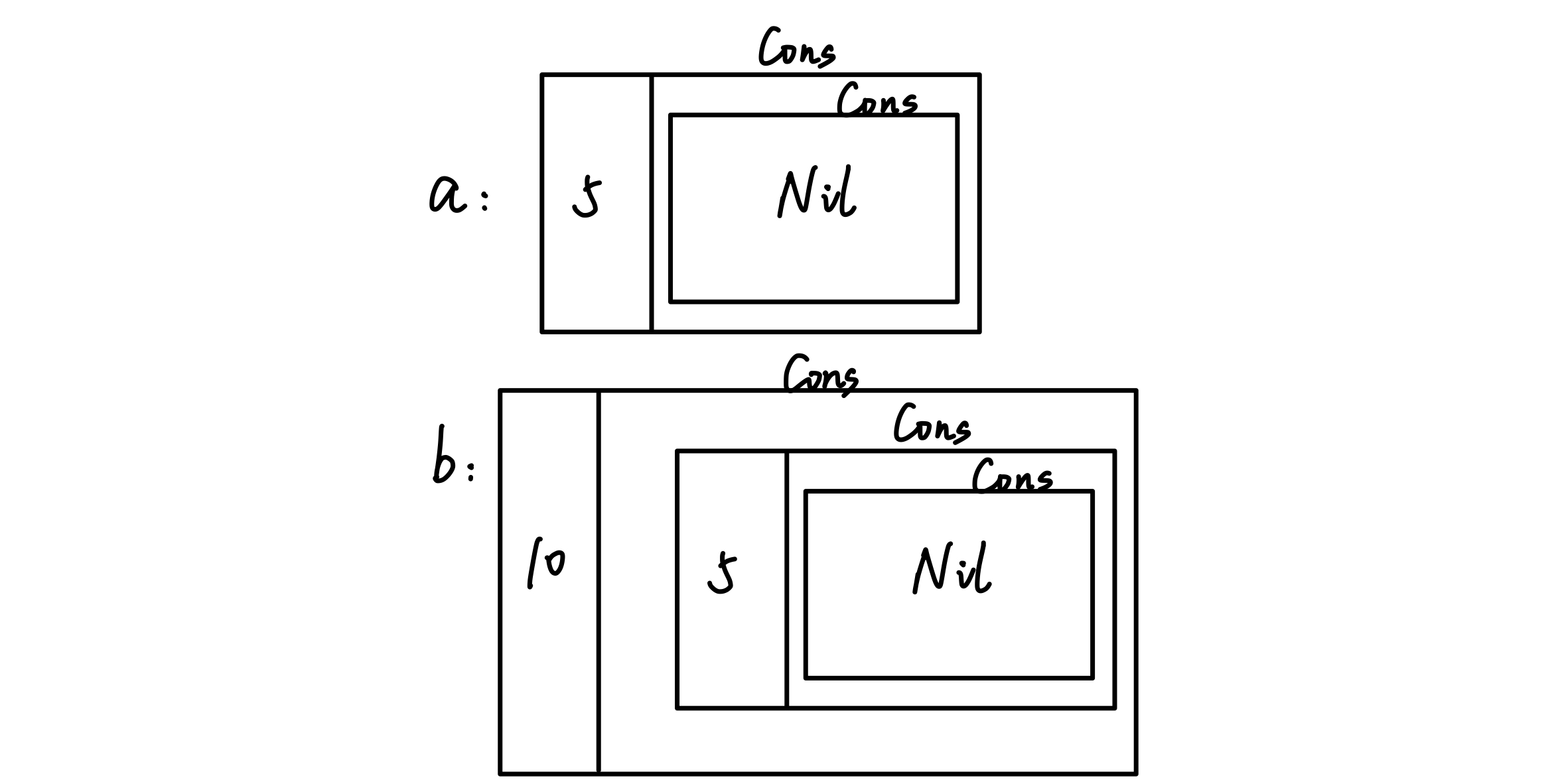
mainalso usesRc::strong_countto get the strong-reference counts ofaandb, uses the customtailmethod to get the second element carried byCons, and prints them withprintln!.- Next, the
if letstatement binds the second value ofa’sConstolink. It usesborrow_mutto obtain a mutable borrow of theRc<List>inside theRefCell, then assigns a clone ofbinto that slot withRc::clone, which changes the internal structure ofainto this: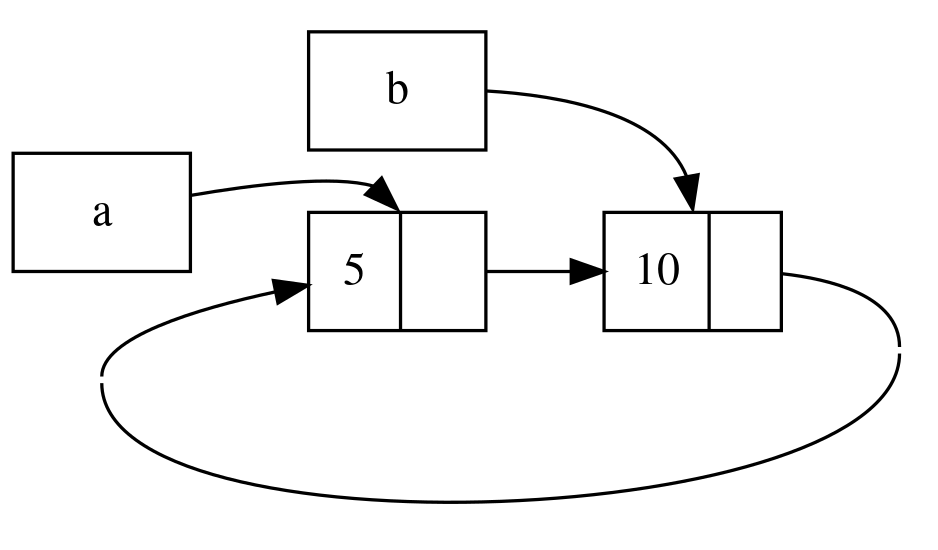
Output:
a initial rc count = 1
a next item = Some(RefCell { value: Nil })
a rc count after b creation = 2
b initial rc count = 1
b next item = Some(RefCell { value: Cons(5, RefCell { value: Nil }) })
b rc count after changing a = 2
a rc count after changing a = 2
- Lines 1 through 5: when
ais first created, the reference count is1. Whenbis declared,ais shared, soa’s reference count becomes2, andbis1. - Lines 6 through 7: the
if letstatement changes the internal structure ofaso thata’s second element points tob, andb’s reference count increases to2. At this point,apoints tob, andbpoints back toa, which creates a reference cycle.
When a and b both go out of scope, Rust drops variable b, which reduces b’s reference count from 2 to 1. At this point, the heap memory for Rc<List> is not deleted because its reference count is 1, not 0. Then Rust drops a, which reduces the reference count of a’s Rc<List> instance from 2 to 1, as shown below. This instance’s memory also cannot be deleted because another Rc<List> instance still references it. The memory allocated for the list will remain unreclaimed forever.
Next, let’s look at what the cycle contains using this line:
#![allow(unused)]
fn main() {
println!("a next item = {:?}", a.tail());
}
Rust will try to print this cycle, where a points to b, which points to a, and so on, until the stack overflows. The final result will be a stack overflow error.
15.7.2 How to Prevent Memory Leaks
So is there any way to prevent memory leaks? That depends on the developer; you cannot rely on Rust alone.
Otherwise, you need to reorganize the data structure so that references are split into ownership-holding and non-owning references. Some references are used to express ownership, and some do not express ownership. In a reference cycle, one part has an ownership relationship, and another part does not. In this way, only the ownership-related links affect whether values are cleaned up.
15.7.3 Replacing Rc<T> with Weak<T> to Prevent Cycles
We know that Rc::clone creates a strong reference to the data and increases the reference count inside Rc<T> by 1, and Rc<T> is cleaned up only when strong_count becomes 0.
However, an Rc<T> instance can create a weak reference to a value by calling Rc::downgrade. The return type of this method is Weak<T> (also a smart pointer). Each call to Rc::downgrade increases weak_count instead of strong_count, so weak references do not affect the cleanup of Rc<T>.
15.7.4 Strong vs. Weak
A strong reference is about how to analyze ownership of an Rc<T> instance. A weak reference does not express ownership, and using it does not create reference cycles: when the strong-reference count becomes 0, the weak references automatically disconnect.
Before using a weak reference, you need to make sure that the value it points to still exists. Calling the upgrade method on a Weak<T> instance returns Option<Rc<T>>, and the Option enum is used to verify whether the value exists.
Take a look at an example:
use std::cell::RefCell;
use std::rc::Rc;

#[derive(Debug)]
struct Node {
    value: i32,
    children: RefCell<Vec<Rc<Node>>>,
}

fn main() {
    let leaf = Rc::new(Node {
        value: 3,
        children: RefCell::new(vec![]),
    });

    let branch = Rc::new(Node {
        value: 5,
        children: RefCell::new(vec![Rc::clone(&leaf)]),
    });
}
The Node struct represents a node with two fields:
- The
valuefield stores the current value, and its type isi32. - The
childrenfield stores child nodes, and its type isRefCell<Vec<Rc<Node>>>.Rc<T>is used here so that all child nodes share ownership. More specifically, we want aNodeto own its child nodes, and we also want to share that ownership with the variable that stores the node itself so that we can directly access everyNodein the tree. To do that, we define theVec<T>items as values of typeRc<Node>.
The requirement here is that each node can point to both its parent node and its child nodes.
Now look at the main function:
leafis created as aNodeinstance, withvalueequal to3andchildrenequal to an emptyVectorwrapped inRefCell.branchis created as aNodeinstance, withvalueequal to5, and itschildrenpoints toleaf.
This means that the Node inside leaf has two owners. At the moment, leaf can be accessed through the children field of branch; however, the reverse is not yet possible through leaf, so we still need to modify it.
To achieve this, we need a bidirectional reference. But bidirectional references create reference cycles, so we need to use Weak<T> to avoid cycles:
#![allow(unused)]
fn main() {
struct Node {
    value: i32,
    parent: RefCell<Weak<Node>>,
    children: RefCell<Vec<Rc<Node>>>,
}
}
We add a parent field to represent the parent node, and we use the weak reference Weak<T>. We do not use Vec<> here because this is a tree structure, and a node can only have one parent.
To write it this way, we need to bring Weak<T> into scope and refactor the code below. The full code after modification is:
use std::cell::RefCell;
use std::rc::{Rc, Weak};

#[derive(Debug)]
struct Node {
    value: i32,
    parent: RefCell<Weak<Node>>,
    children: RefCell<Vec<Rc<Node>>>,
}

fn main() {
    let leaf = Rc::new(Node {
        value: 3,
        parent: RefCell::new(Weak::new()),
        children: RefCell::new(vec![]),
    });

    println!("leaf parent = {:?}", leaf.parent.borrow().upgrade());

    let branch = Rc::new(Node {
        value: 5,
        parent: RefCell::new(Weak::new()),
        children: RefCell::new(vec![Rc::clone(&leaf)]),
    });

    *leaf.parent.borrow_mut() = Rc::downgrade(&branch);

    println!("leaf parent = {:?}", leaf.parent.borrow().upgrade());
}
After leaf is created, we first print the contents of its parent field (at this point, parent does not have any value yet). After branch is created, we print the contents of leaf’s parent field again (at this point, its value is branch).
The statement *leaf.parent.borrow_mut() = Rc::downgrade(&branch); creates a Weak<Node> pointing to branch and stores it in leaf’s parent field:
leaf.parentis the field that representsleaf’s parent node. Its type isRefCell<Weak<Node>>, so we can useborrow_mutto get aRefMut<Weak<Node>>.- The dereference operator
*lets us access the innerWeak<Node>value stored insideRefMut<Weak<Node>>. - The
downgrademethod creates aWeak<Node>frombranchand assigns it toparent.
Output:
leaf parent = None
leaf parent = Some(Node { value: 5, parent: RefCell { value: (Weak) }, children: RefCell { value: [Node { value: 3, parent: RefCell { value: (Weak) }, children: RefCell { value: [] } }] } })
- The first print shows that the
parentfield has not yet been assigned, so its value is theNonevariant underOption. - The second print shows that the parent node has been set to
branch, and the fact that the output does not go on forever shows that this code does not create a reference cycle.
Finally, let’s modify main by adding print statements and changing scopes to see the numbers of strong and weak references:
fn main() {
    let leaf = Rc::new(Node {
        value: 3,
        parent: RefCell::new(Weak::new()),
        children: RefCell::new(vec![]),
    });

    println!(
        "leaf strong = {}, weak = {}",
        Rc::strong_count(&leaf),
        Rc::weak_count(&leaf),
    );

    {
        let branch = Rc::new(Node {
            value: 5,
            parent: RefCell::new(Weak::new()),
            children: RefCell::new(vec![Rc::clone(&leaf)]),
        });

        *leaf.parent.borrow_mut() = Rc::downgrade(&branch);

        println!(
            "branch strong = {}, weak = {}",
            Rc::strong_count(&branch),
            Rc::weak_count(&branch),
        );

        println!(
            "leaf strong = {}, weak = {}",
            Rc::strong_count(&leaf),
            Rc::weak_count(&leaf),
        );
    }

    println!("leaf parent = {:?}", leaf.parent.borrow().upgrade());
    println!(
        "leaf strong = {}, weak = {}",
        Rc::strong_count(&leaf),
        Rc::weak_count(&leaf),
    );
}
The logic of the code is:
-
After creating
leaf, print how many strong and weak references it has. -
After that, add
{}to create a new scope:- Put the declaration of
branchand the operation that assignsleaf’s parent inside it. - Print the numbers of strong and weak references for
branchandleafat that moment.
- Put the declaration of
-
After leaving the scope:
- Print
leaf’sparent - Print the strong and weak references of
leaf
- Print
Output:
leaf strong = 1, weak = 0
branch strong = 1, weak = 1
leaf strong = 2, weak = 0
leaf parent = None
leaf strong = 1, weak = 0
- Line 1:
leafis created with one strong reference. - Line 2:
branchis created. Afterleaf.parentis set withRc::downgrade(&branch),branchhas one strong reference and one weak reference—the weak count comes fromleaf’sparentfield, not frombranch’s own emptyWeak::new(). - Line 3:
branch.childrenholds a strong reference toleaf, and theleafvariable is also a strong reference, soleafhas two strong references now. - Line 4: because
branchhas already gone out of scope,leaf’sparentfield is nowNone. - Line 5:
branchgoing out of scope causes its strong reference toleafto become invalid, reducingleaf’s strong references by 1 to 1.