15.5 Rc<T> - Reference-Counting Smart Pointer and Shared Ownership
15.5.1 What Is Rc<T>
Ownership is clear in most situations. For a given value, a programmer can accurately infer which variable owns it.
However, in some scenarios, a single value can be held by multiple owners at the same time, as shown below:
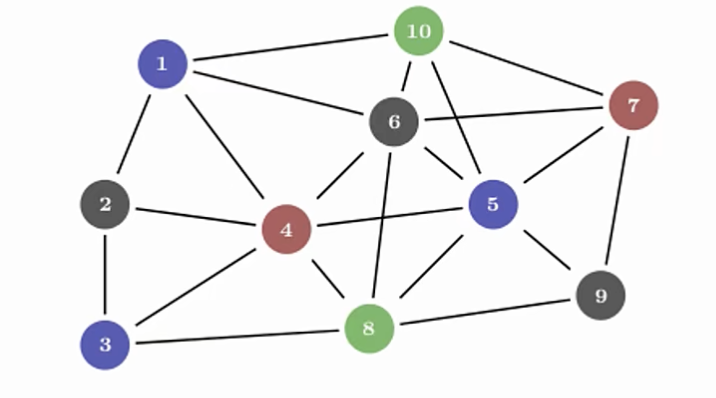
In this data structure, each node has multiple edges pointing to it, so conceptually those nodes belong to every edge pointing at them at the same time. As long as a node still has edges pointing to it, it should not be cleaned up. This is multiple ownership.
To support multiple ownership, Rust provides the Rc<T> type. Rc is short for Reference Counting. This type maintains a counter inside the instance to record how many references point to the value, so it can determine whether the value is still in use. If the reference count is 0, the value can be safely cleaned up, and no dangling-reference problems will occur.
15.5.2 Use Cases for Rc<T>
You can use Rc<T> when you want to share some heap data among multiple parts of a program, but at compile time you cannot determine which part of the program will be the last one to use that data.
Conversely, if we can determine at compile time which part of the program will use the data last, then we only need to make that part of the code the owner. In that case, the compile-time ownership rules are enough to guarantee correctness.
It is worth noting that Rc<T> can only be used in single-threaded scenarios. Later articles will discuss how to use reference counting in multi-threaded code.
15.5.3 Example of Rc<T> in Use
Before using it, note that Rc<T> is not in the prelude, so you must import it manually first.
Rc has a few basic functions:
Rc::clone(&a)increases the reference countRc::strong_count(&a)returns the reference count, specifically the strong-reference count- Since there are strong references, there are also weak references, that is,
Rc::weak_count
Let’s explore the actual use of Rc<T> with an example:
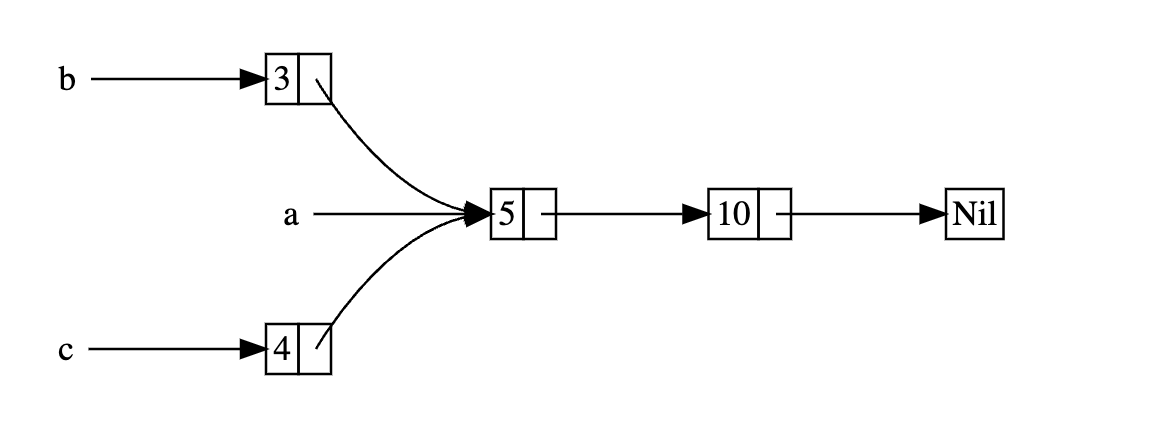
There are three Lists, named a, b, and c. b and c share a. Other details are shown in the diagram:
enum List {
    Cons(i32, Box<List>),
    Nil,
}

use List::{Cons, Nil};

fn main() {
    // Newlines in main are only to make the list structure clearer; they are not required.
    let a = Cons(5,
                 Box::new(Cons(10,
                               Box::new(Nil))));

    let b = Cons(3,
                 Box::new(a));
    let c = Cons(4,
                 Box::new(a));
}- First we create a linked list
List; its structure was explained in detail in 15.1. UsingBox<T>to Point to Data on the Heap, so we will not repeat it here. - In
main, we first write out the structure ofa. - Then we write the first layer of
bandc; for the nested next layer, we just writea.
There is no logical problem, so let’s run it:
error[E0382]: use of moved value: `a`
  --> src/main.rs:17:27
   |
10 |     let a = Cons(5,
   |         - move occurs because `a` has type `List`, which does not implement the `Copy` trait
...
15 |                  Box::new(a));
   |                           - value moved here
16 |     let c = Cons(4,
17 |                  Box::new(a));
   |                           ^ value used here after move
   |
note: if `List` implemented `Clone`, you could clone the value
  --> src/main.rs:1:1
   |
 1 | enum List {
   | ^^^^^^^^^ consider implementing `Clone` for this type
...
15 |                  Box::new(a));
   |                           - you could clone this value

For more information about this error, try `rustc --explain E0382`.
error: could not compile `rc-list` (bin "rc-list") due to 1 previous error
The error says that a moved value was used. This is because when b was written, a was moved into b, so ownership of a was transferred to b.
How do we fix this?
One way is to change the definition of List so that Cons holds a reference instead of ownership, and then give it the corresponding lifetime parameter. But that lifetime parameter would require every element in List to live at least as long as List itself. The borrow checker will prevent us from compiling such code:
#![allow(unused)]
fn main() {
let a = Cons(10, &Nil);
}
Nil is a zero-sized enum variant, but in the expression Cons(10, &Nil) or &Nil, the compiler treats it as a temporary value. This temporary value usually only lives for the current statement (or an even smaller scope), and then it is automatically dropped.
Simply put, &Nil is a temporary value that is used and then destroyed, so its lifetime is shorter than that of the enum. The temporary Nil variant value is dropped before a can take a reference to it.
The correct approach is to use Rc<T>, a reference-counting smart pointer, to let multiple owners share the same heap data and automatically free the memory when no owners remain:
enum List {
    Cons(i32, Rc<List>),
    Nil,
}

use List::{Cons, Nil};
use std::rc::Rc;

fn main() {
    // Newlines in main are only to make the list structure clearer; they are not required.
    let a = Rc::new(Cons(5,
                         Rc::new(Cons(10,
                                      Rc::new(Nil)))));

    let b = Cons(3,
                 Rc::clone(&a));
    let c = Cons(4,
                 Rc::clone(&a));
}
When declaring b and c, we use Rc::clone and pass &a as the argument, so b and c do not take ownership of a. Each time Rc::clone is used, the reference count inside the smart pointer increases by 1.
When a is created, Rc::new counts as the first reference, so the counter is 1. b and c each use Rc::clone once, so the count increases by 1 each time, and the final count is 3. The data inside the a smart pointer is cleaned up only when the reference count becomes 0.
In fact, Rc<T> implements the Clone trait, so writing a.clone() when assigning b and c is also possible—it calls the same method as Rc::clone(&a). But because this may be misunderstood as a deep copy—especially by beginners—while it actually only increases the reference count, it is not recommended. Rc::clone is the better choice.
Next, let’s modify main and print some helpful information to see how the reference count changes when c goes out of scope:
fn main() {
    let a = Rc::new(Cons(5, Rc::new(Cons(10, Rc::new(Nil)))));
    println!("count after creating a = {}", Rc::strong_count(&a));
    let b = Cons(3, Rc::clone(&a));
    println!("count after creating b = {}", Rc::strong_count(&a));
    {
        let c = Cons(4, Rc::clone(&a));
        println!("count after creating c = {}", Rc::strong_count(&a));
    }
    println!("count after c goes out of scope = {}", Rc::strong_count(&a));
}
Here, c goes out of scope before a and b, so the reference count decreases by 1 after c goes out of scope.
Output:
count after creating a = 1
count after creating b = 2
count after creating c = 3
count after c goes out of scope = 2
What we do not see in this example is that when b and a go out of scope at the end of main, the count becomes 0, and Rc<List> is fully cleaned up.
Because Rc<T> implements the Drop trait, the reference counter is automatically decremented by 1 when Rc<T> goes out of scope. Using Rc<T> allows a single value to have multiple owners, and the count ensures that the value remains valid as long as any owner still exists.
15.5.4 Summary of Rc<T>
Rc<T> allows programmers to share read-only data between different parts of a program through immutable references.
Again, Rc<T> references are immutable. If Rc<T> allowed programmers to hold multiple mutable references, it would violate the borrow rules—multiple mutable references to the same region would lead to data races and inconsistent data.
In real development, you will certainly encounter cases where data needs to be mutable. For that, Rust provides the interior mutability pattern and RefCell<T>, and programmers can combine it with Rc<T> to handle this immutability restriction. That is what the next article will discuss.